


How it works vibrating screen?
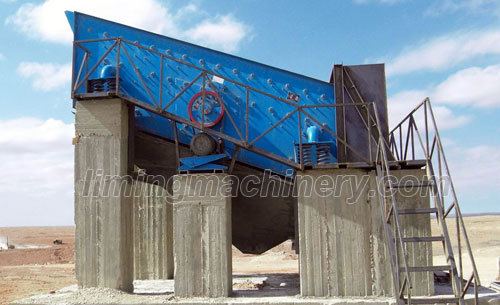
How it works vibrating?
Vibrating Screen Introduction:
Vibrating Screen are used to separate materials into various sizes for further processing, or for final use. Depending on what we need, the material is separated by passing it through a vibrating “screen box” which has a number of different sized screens, or meshes, which the material falls through like a sieve, the material falls onto attached conveyors which stock pile the end products. The end products can then be used in the building and construction industries.
Vibrating Screen is widely used for grading and screening materials in the following fields: minerals, quarry, building materials, water conservancy and hydropower, transportation, stone industry, smelting and so on.
Vibrating Screen Features:
1, to improve product purity, eliminate oversized material, powder and liquid.
2, increase your productivity, double-click you half the size of the throughput. Vibrating Screen to achieve higher throughput per unit grid area than conventional vibration sieve, and can achieve throughput of up to 60,000 kg / hr .
3, reduce downtime, Russell contract sieve can be easily peeled off, no tools required cleaning.
To eliminate dust and smoke, and closed screening means that the total containment.
5, suitable for small space, the shaker can be easily integrated into existing facilities and limited clearance zone.
6, lower noise levels, a solid stone suspension to provide a quiet operation machine - usually as 70dBA.
7, operation and cleaning is fast and convenient, this shaker suitable for all range of processing industries.
How it works vibrating?
It uses eccentric block to produce strong exciting force. Crossbeam and the main body of the vibrating screen are connected with high strength screw bolts. So they have the features of simple structure and easy maintenance. It adopts tire clutch with capability of flexible connection and stable operation. It adopts the structure of small amplitude, high frequency, large obliquity to make the screen hold the capability of high efficiency, large handling capacity, long life span, low consumption, and little noise.
In screen grading, the material is separated mechanically on screen plates. Rolling bearings in vibrating screens are stressed by high, mostly shock-type loads. Moreover, the bearings, while rotating about their own axis, perform a circular, elliptical or linear vibrating motion. This results in high radial accelerations which additionally stress the bearings, and especially the cages, considerably. The operating speeds are usually very high. As a result, the bearing temperatures are up to 20 to 30 degrees Kelvin higher than in normal applications. In addition, considerable misalignments between the bearing locations and considerable shaft deflections have to be accommodated.




